
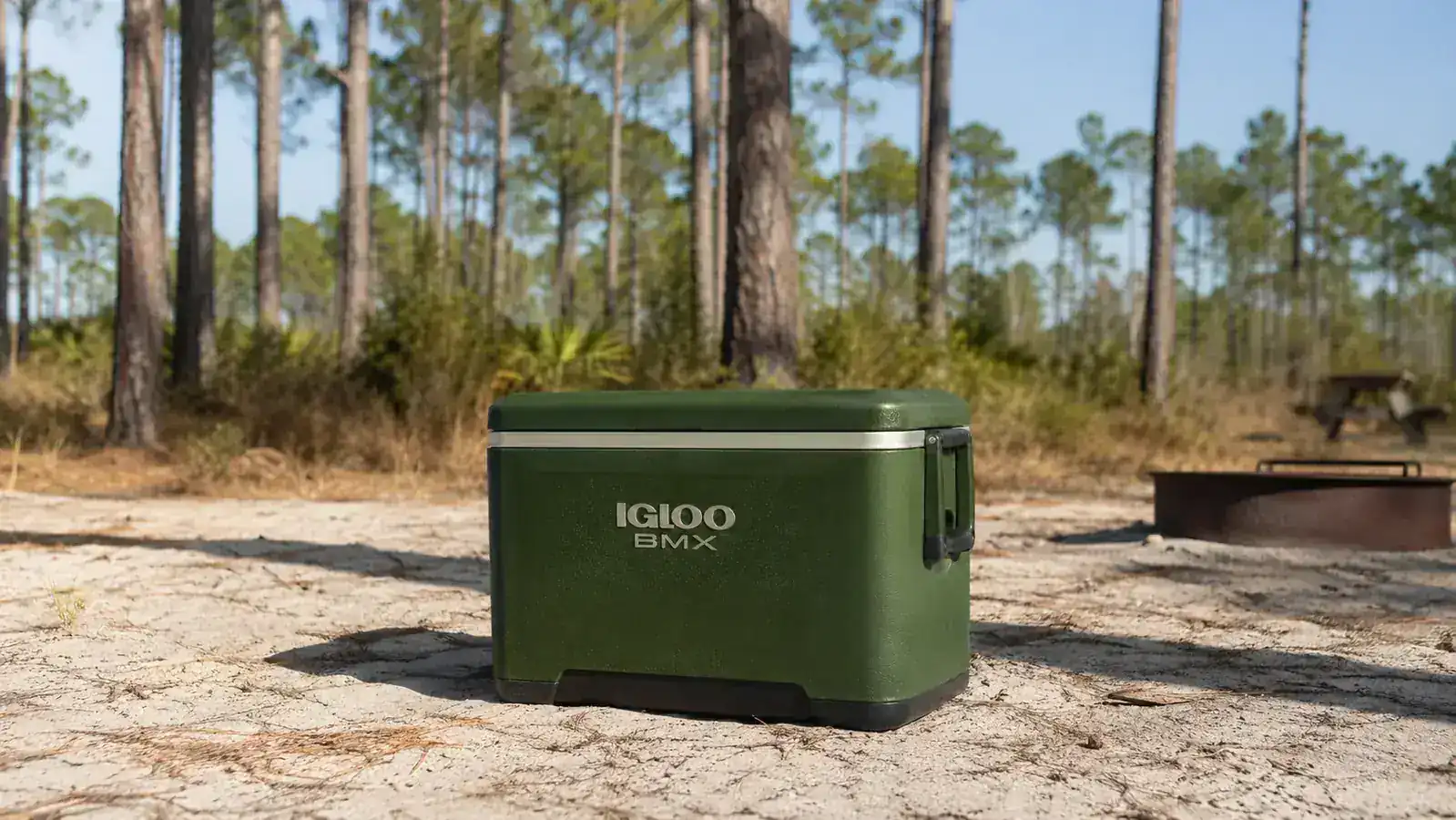
I bought the Igloo BMX 52-quart on a Tuesday and took it on a four-day solo trip to the Ocala National Forest that Friday. The Amazon listing said "up to 5 days of ice retention" and I believed it, packed the cooler with cubed ice from a gas station and four days of food, set it in the back of my Jeep, and drove three hours south into central Florida in July. By the afternoon of day three, I had warm beer and a hard decision about whether the raw chicken I hadn't cooked yet was still safe. It was not a great start.
Here is the thing: the Igloo BMX is a genuinely good cooler. I still use it. I'd still recommend it to most campers. But after a full season of trips, I've figured out the gap between what the marketing suggests and what the cooler actually does. These are the six things I wish someone had told me before I pulled the trigger, because knowing them changes how you use it and whether it is the right cooler for your specific situation.
The Quick Verdict
Excellent value for weekend car camping, but ice performance is heavily dependent on packing technique and shade placement in a way the product listing doesn't prepare you for.
Amazon Check Today's Price →Know these six quirks upfront and the Igloo BMX becomes a much better cooler.
It is available on Amazon in multiple sizes. The 52-quart handles four days for one to two people when packed correctly. Check the current price before your next trip.
Amazon Check Today's Price on Amazon →Thing 1: Ice Life Is a Packing Problem, Not a Cooler Problem
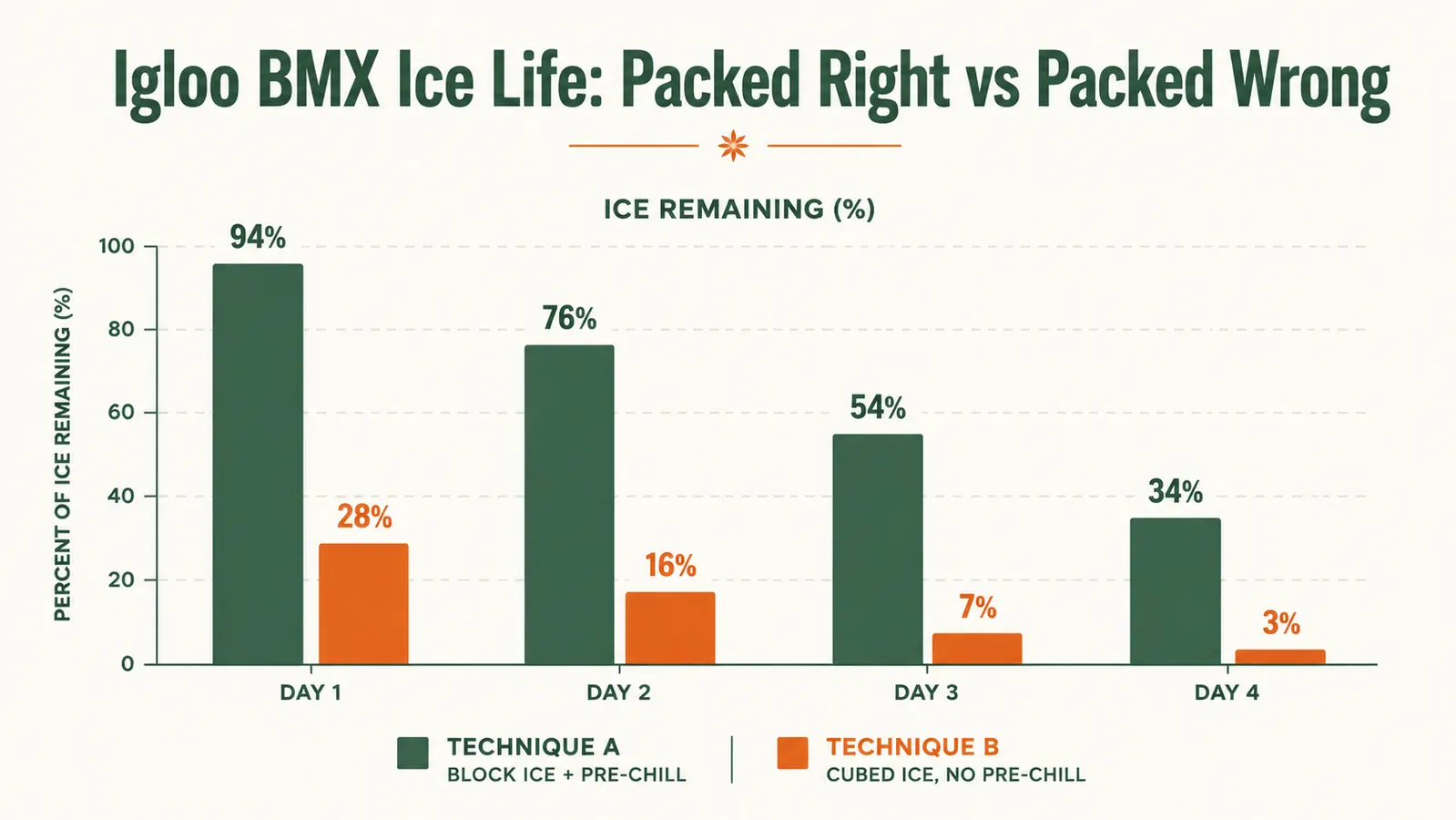
The biggest lesson from my disastrous Ocala trip was not about the cooler itself. It was about what I put inside it and how. Gas-station cubed ice melts faster than block ice because it has a much higher surface-area-to-volume ratio. You're essentially giving the heat more ice to attack. I used cubed ice, did not pre-chill the cooler, and did not put any ice at the bottom first. I also opened the cooler several times in the afternoon heat to get snacks. All of those choices cost me about a day and a half of ice life that had nothing to do with the insulation quality of the BMX itself.
I ran the same four-day trip the following month with a different approach: I put two frozen water bottles in the empty cooler the night before departure to pre-chill the interior walls, used a 10-lb block of ice at the bottom (bought from a gas station that sold blocks, not cubed), packed food on top of the block with any cubed ice filling the gaps, and kept the cooler in the shade of my tarp canopy whenever I was at camp. Same ambient temperatures, same trip length, same person opening it. That time I had usable ice remaining on the morning of day four. The BMX's insulation had not changed. My technique had.
This matters because a lot of negative reviews of the BMX are really reviews of bad packing practices. The cooler's foam insulation is not the limiting factor on a three- to four-day trip for most people. The limiting factor is how much warm air gets in, how much thermal mass you started with, and whether ambient heat has a direct shot at the exterior. Fix those and the cooler performs well.
Thing 2: Direct Sun Is the Biggest Threat to Ice Life
I mentioned shade above, but this deserves its own section because the numbers are stark. On my Ocala trip in July, the ambient air temperature in shade was around 88 degrees Fahrenheit. The surface temperature of a dark-colored object in direct Florida afternoon sun in July can reach 130 to 150 degrees Fahrenheit. Even though the BMX foam does insulate the interior from that exterior surface heat, there is a meaningful difference between a 90-degree exterior temperature and a 140-degree exterior temperature when you are fighting melting ice for four days.
The BMX I own is the graphic wrap version in a dark olive-and-tan color scheme. It looks good. It also absorbs more solar heat than a white or light-colored cooler. If you are going to be camping in a hot climate with unavoidable sun exposure, the lighter-colored BMX variants or the plain tan model will outperform the dark graphic wraps in real-world conditions. It is a small edge, but over four days in a southern summer, it adds up. I've since started keeping the cooler under my tarp whenever I'm at camp, and that single habit change probably adds three to four hours of ice life per day.
Thing 3: Check the Lid Gasket Before You Leave the Store
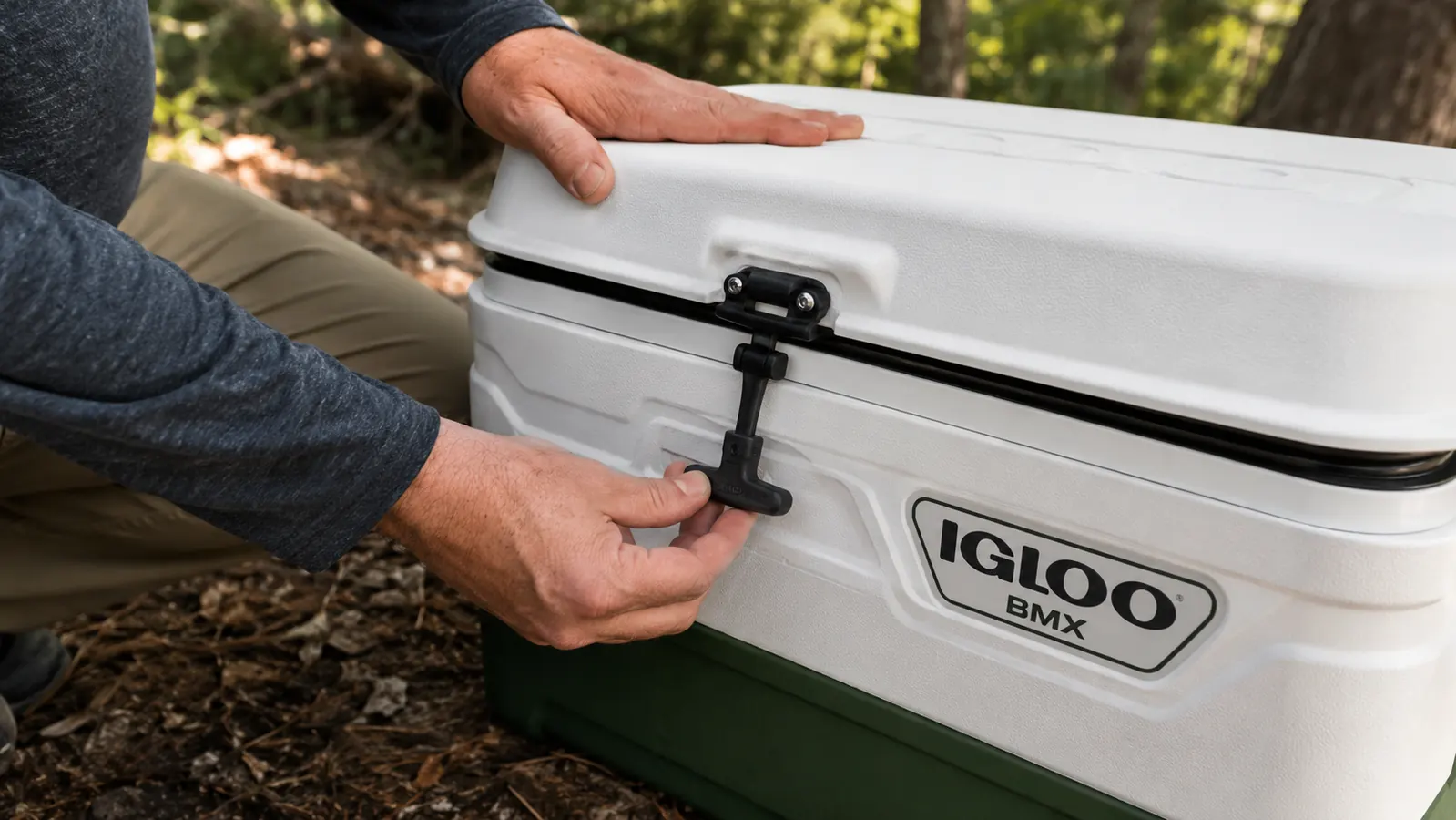
The BMX has a continuous foam gasket that runs around the perimeter of the lid and creates the seal when you close it. This gasket is the single most important component for ice retention. On my cooler, the gasket arrived with one small section near the rear hinge that wasn't fully seated in its channel. It was not obvious from a quick look, but when I ran my finger around the interior lid edge on my second trip, I found that spot. Cold air was leaking out at that point every time the lid was closed.
The fix was easy: I pressed the gasket back into the channel and it stayed. But I would have caught that at the store if I had done a five-second check before buying. The fix for a fully dislodged or damaged gasket is a foam weatherstripping replacement from a hardware store, cut to fit. It is a five-dollar repair and it works fine. The point is: inspect the gasket on any hard-sided cooler before you rely on it for a multi-day trip. On the BMX this is especially worth checking because the foam gasket design does not have the mechanical backup that some higher-end coolers use.
The gasket is the most important part of the cooler. Run your finger around the interior lid edge before you leave. I found a gap on mine that had been leaking cold air on two trips before I noticed.
Thing 4: The Weight Sneaks Up On You
The Igloo BMX 52-quart weighs about 20 lbs empty. When I loaded it with 10 lbs of block ice, 5 lbs of cubed ice, and four days of food for one person, the total came to about 47 lbs. That felt manageable. When I switched to a two-person load with 20 lbs of ice and two people's worth of food, that same cooler hit 62 lbs. At 62 lbs, the molded side handles are fine for short moves on flat ground. On anything uneven, two people and four hands are genuinely necessary.
The BMX does not have wheels or a telescoping handle, which is fine for most car camping where you're moving it 30 feet from a truck bed to a picnic table. But if your campsite is 200 feet from your parking spot, or if you need to stage gear on a slope, plan to have a partner for the carry. I've seen people try to carry a fully loaded 52-quart BMX solo across a gravel campsite loop. It is technically possible but uncomfortable, and the side handles are not designed for that kind of distance.
The smaller BMX sizes, the 25-quart and 38-quart, are considerably more manageable solo when fully loaded. If your camping is solo or duo and you are making any kind of carry from a vehicle, consider whether the 52-quart is actually the size you need or whether you are buying more capacity than you'll use.
Thing 5: It Is Not Bear-Resistant
This is the one that I have seen cause real confusion online. The Igloo BMX has heavy-duty construction, molded plastic latches, and a generally rugged look that some buyers assume translates to wildlife resistance. It does not. The BMX is not IGBC-certified (Interagency Grizzly Bear Committee) and should not be stored unattended at a campsite in active bear country overnight.
I took the BMX to a campsite in northern Georgia last September where bear activity had been reported. I kept the cooler in my locked vehicle at night, which is both the right practice and the only reliable practice for non-certified coolers. If you camp regularly in places with required bear-box or certified-container rules (most designated wilderness areas in the Western US, some sites in the Southeast), you need a cooler that is specifically IGBC certified, which means rotomolded construction and reinforced latch systems designed to resist roughly 60 pounds of prying force. The BMX does not meet that standard and doesn't claim to. But the listing doesn't say that clearly either, so I'm saying it here.
Thing 6: The Value Case Has a Clear Ceiling
The Igloo BMX sits at a price point that makes it a compelling mid-range option. It significantly outperforms a cheap box-store cooler and significantly undercuts a premium rotomolded cooler. That value proposition is real and I don't want to undersell it. But the value case has a ceiling.
If you camp more than eight or ten nights per year, do trips longer than five nights regularly, or camp in regions where ambient temperature regularly exceeds 90 degrees in exposed conditions, the BMX will start to feel like a limiting factor. At that point, the comparison you should be making is not BMX versus budget cooler. It is BMX versus an RTIC or Orca or Pelican rotomolded cooler, which cost roughly 1.5 to 2 times what the BMX costs and will give you measurably more ice life per trip with less technique dependency. The gap between a well-packed BMX and a well-packed rotomolded cooler is roughly two days of ice life under hard conditions. Over ten trips a year, that gap changes how you eat and drink on longer excursions.
Conversely, if you car camp eight to twelve nights a year on two- to four-night trips at sites within reach of civilization, the BMX is very likely the right level of cooler. Paying 2.5 times more for performance you don't functionally need because you can make an ice run is a poor trade. That is where this cooler lives: it is not an entry-level purchase, but it is not trying to be a Yeti either. Knowing which camp you're in before you buy will tell you whether it's the right cooler or whether you're better served by spending more.
What I Liked
- Solid ice retention when packed correctly with block ice and a pre-chilled interior
- Noticeably better construction than budget plastic coolers, with real hinge quality
- 52-quart capacity is well-matched to one to two people for three to four nights
- Multiple size and color options including plain light-colored versions that reduce solar heat gain
- Available on Amazon with fast shipping and a straightforward return window if it doesn't fit your needs
- Replacement parts (gasket material, latches) are inexpensive and widely available
Where It Falls Short
- Ice performance is highly technique-dependent in a way the listing doesn't make clear
- Dark graphic wrap versions absorb more solar heat than light colors in exposed conditions
- Lid gasket can arrive partially unseated and should be inspected before first use
- No wheels or extended carry system on any BMX size
- Not IGBC bear-resistant certified and should not be treated as such in bear country
- Value ceiling is real: heavy users doing long remote trips will outgrow it quickly
Who This Is For
The Igloo BMX is the right cooler for car campers who want meaningfully better-than-budget performance without the premium price, are willing to spend five minutes pre-chilling and packing correctly, and are camping at sites where some shade placement is possible. If you match those conditions, this cooler will not disappoint you on a three- to four-night trip. It is also a strong choice as a dedicated drink cooler at a longer base camp, where the food lives in a premium cooler and the BMX handles drinks with slightly less stress on its ice life.
Who Should Skip It
Skip the BMX if you are doing remote trips where resupply is not an option and your trip length runs past four nights in summer temperatures. Skip it if you camp in areas with mandatory bear-canister requirements. Skip it if you need to carry the cooler more than 50 feet from your vehicle regularly, particularly on uneven terrain. And skip it if you are a heavy camping user who will be running more than a dozen nights a season on four- to five-night trips, because you will end up frustrated and wishing you had spent the extra money upfront on something with longer certified ice life.
Know what you're getting and the Igloo BMX punches well above its price. Here is where to check current availability.
The 52-quart is the most versatile size for most campers. The 25-quart and 38-quart are worth looking at if you want a solo-carry option. All sizes are on Amazon with current pricing below.
Amazon Check Today's Price on Amazon →