
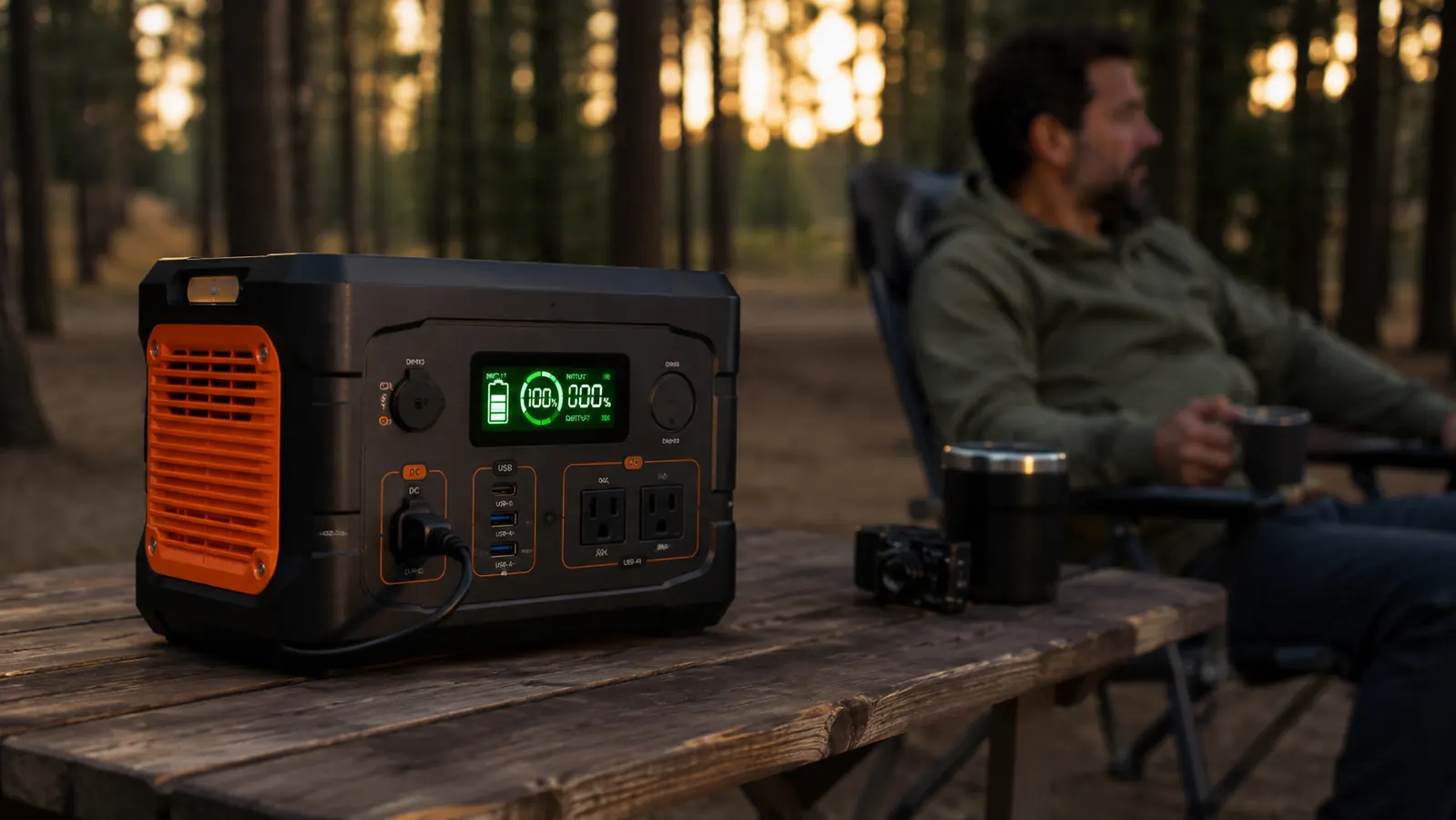
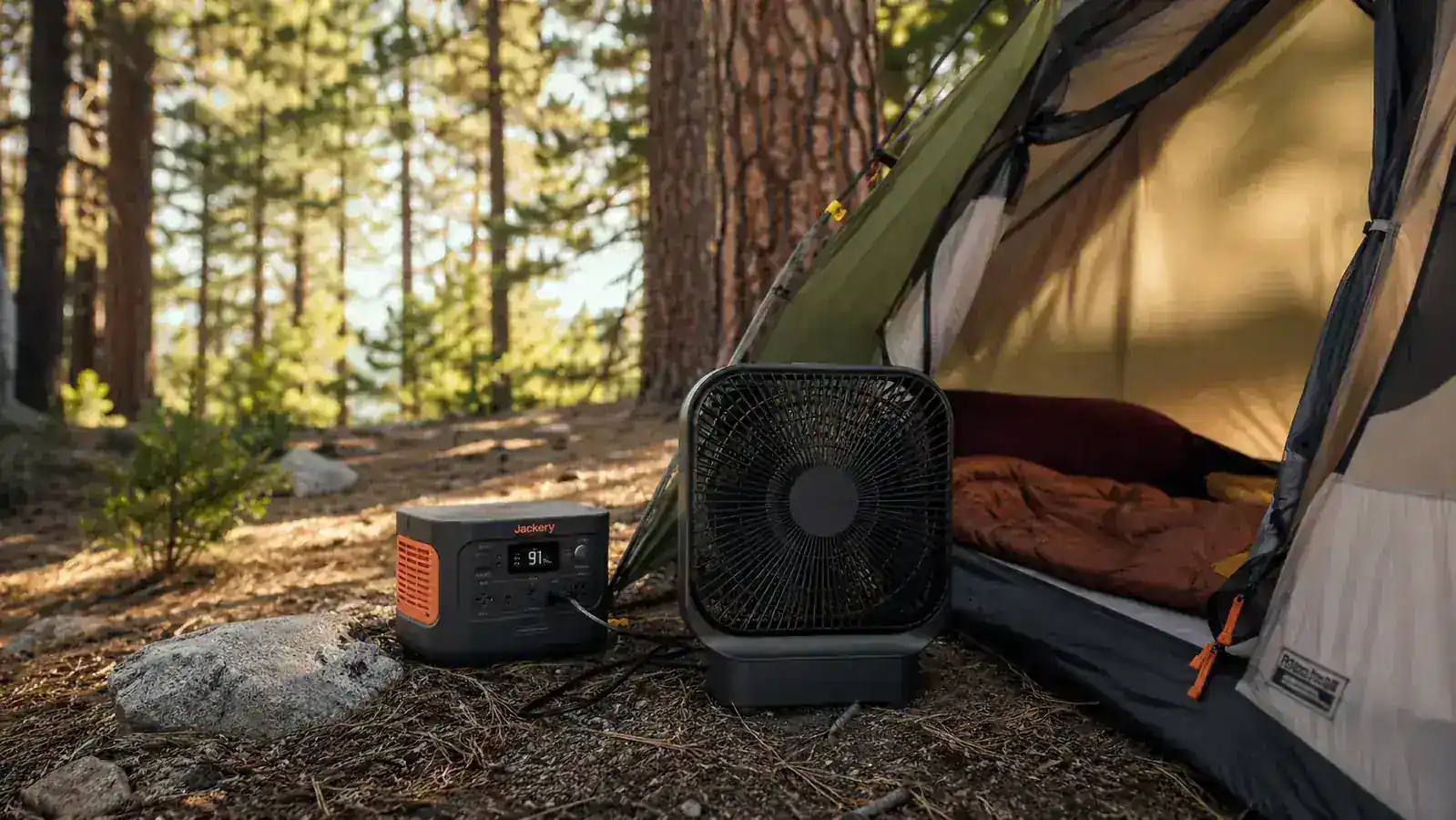
Before my last camping trip, I spent two evenings on YouTube watching people run blenders and mini-fridges off portable power stations and declaring them life-changing. I bought the Jackery Explorer 300 with those videos still fresh in my head. Then I got to my campsite in Ocala National Forest with my wife and our seven-year-old daughter, plugged in our box fan, turned on the LED light string, and started charging three phones. By 6 a.m., the unit was at 12 percent. I had not run anything unusual. I just had not done the math beforehand.
That experience is exactly what this review is about. The Jackery Explorer 300 is a genuinely well-built, reliable piece of gear. I have used it on eight camping weekends now, and I understand it a lot better than I did that first night. What nobody tells you in the glowing reviews is how quickly real camping loads eat through 292 watt-hours, and which specific use cases will leave you staring at a blinking red battery icon at two in the morning. I am going to give you the numbers and the honest take so you can decide if this station fits your actual camping style.
The Quick Verdict
A well-made, dead-simple power station that handles light camp loads and phone charging reliably. The 292Wh capacity is the real constraint: one fan overnight plus lights and charging will drain it before morning. Know your loads before you buy.
Amazon Check Today's Price →Running out of power at 2 a.m. ruins a camping trip. Know what you are getting before you buy.
The Jackery Explorer 300 is a strong choice for light-load campers. Check today's price and available bundles on Amazon before your next trip.
Amazon Check Today's Price on Amazon →What the Spec Sheet Says vs What I Actually Experienced
Jackery rates the Explorer 300 at 292 watt-hours. That number sounds generous until you understand the conversion losses and the loads you are actually running. A portable box fan drawing 35-50 watts, run for nine hours overnight, consumes roughly 380-450 watt-hours before losses. The Explorer 300 holds 292Wh and delivers around 250-260Wh of usable power after inverter conversion losses (roughly 85-90 percent efficiency). That means the fan alone exceeds capacity before sunrise. Add a phone charging at 10 watts and a small LED light string at 5 watts, and you will see the battery drop by roughly 10 percent per hour under combined load.
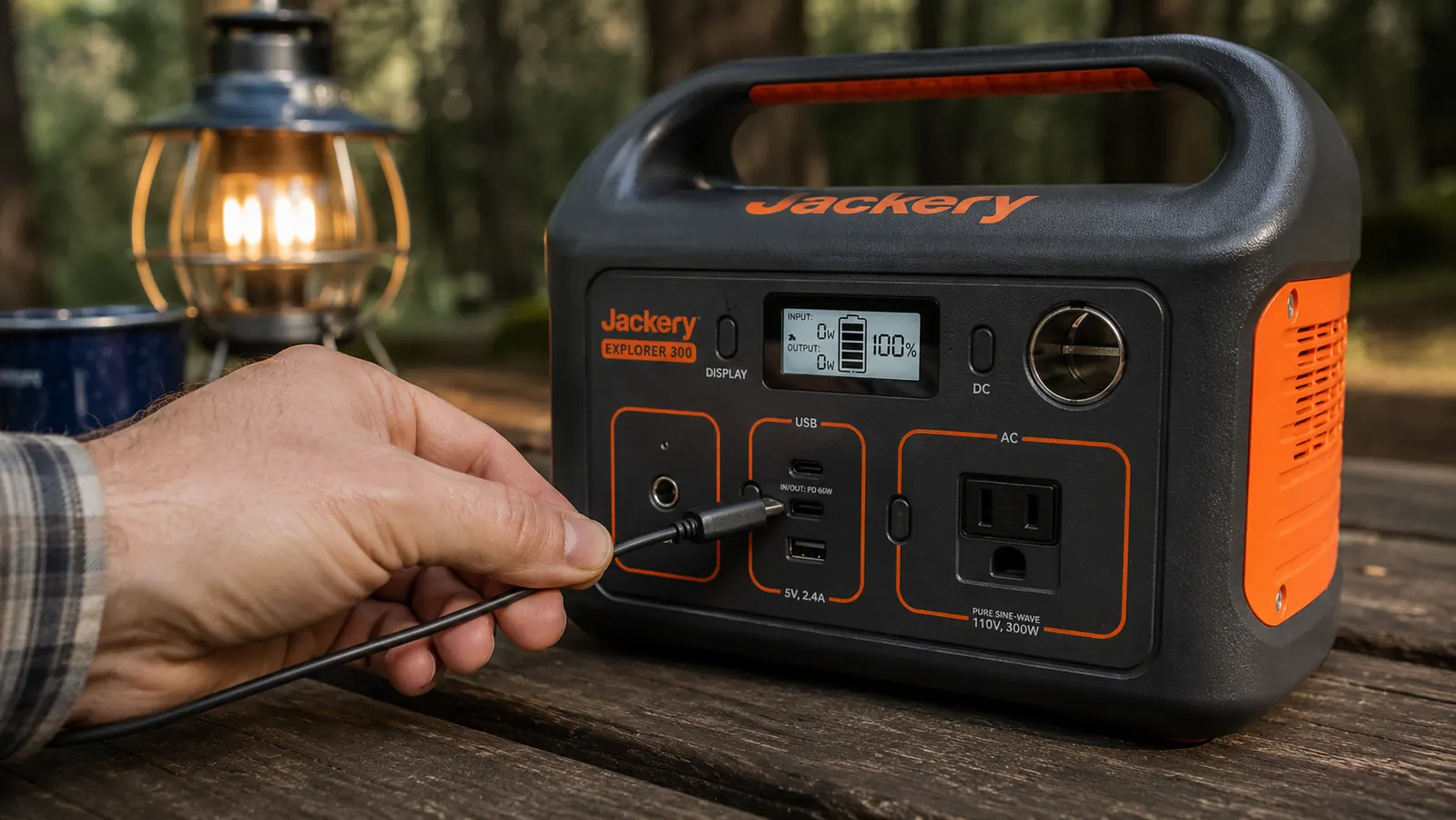
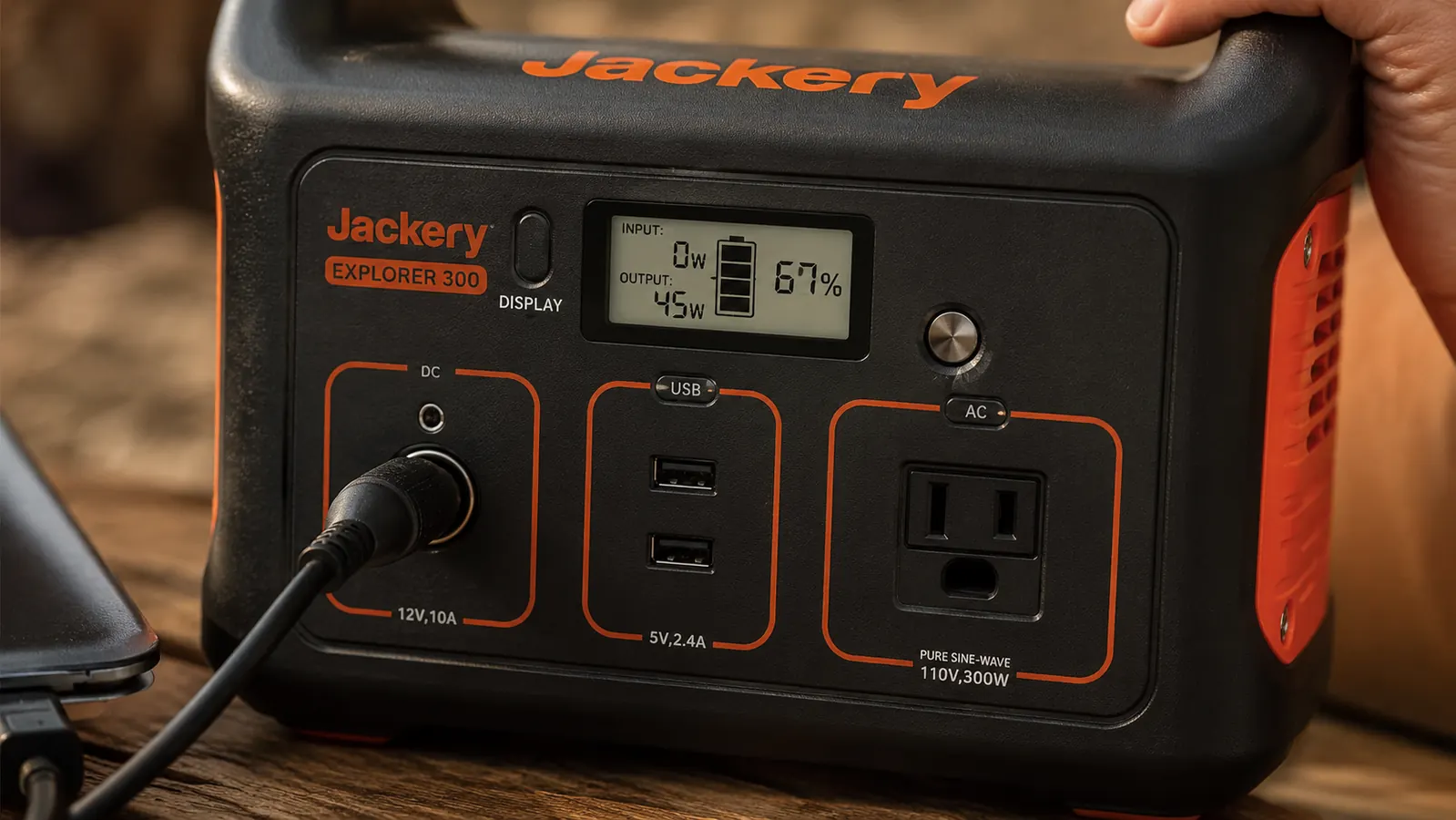
Jackery lists a 500W pure-sine AC inverter, two AC outlets, a 60W USB-C port, two USB-A ports, and a 12V carport. The spec sheet is accurate. What it does not tell you is that the unit gets warm (not hot, but noticeably warm) when running the AC inverter at loads above 200W, and the cooling fan inside spins up audibly at high draw. On trips where I was running only lights and phone charging, the unit was silent. The moment I plugged in a device drawing 150W or more, I could hear the internal fan from a few feet away inside the tent.
The display is one of the best features on this unit. It shows battery percentage, input wattage when charging, and output wattage when discharging. That real-time wattage readout is genuinely useful. The first time I plugged in my daughter's nebulizer (we keep it in the camping kit for emergencies), I could see instantly that it was pulling 140W and recalculate my remaining runtime on the spot. That kind of transparency is not universal at this price point, and I appreciate it.
The Six Things Nobody Warns You About Before You Buy
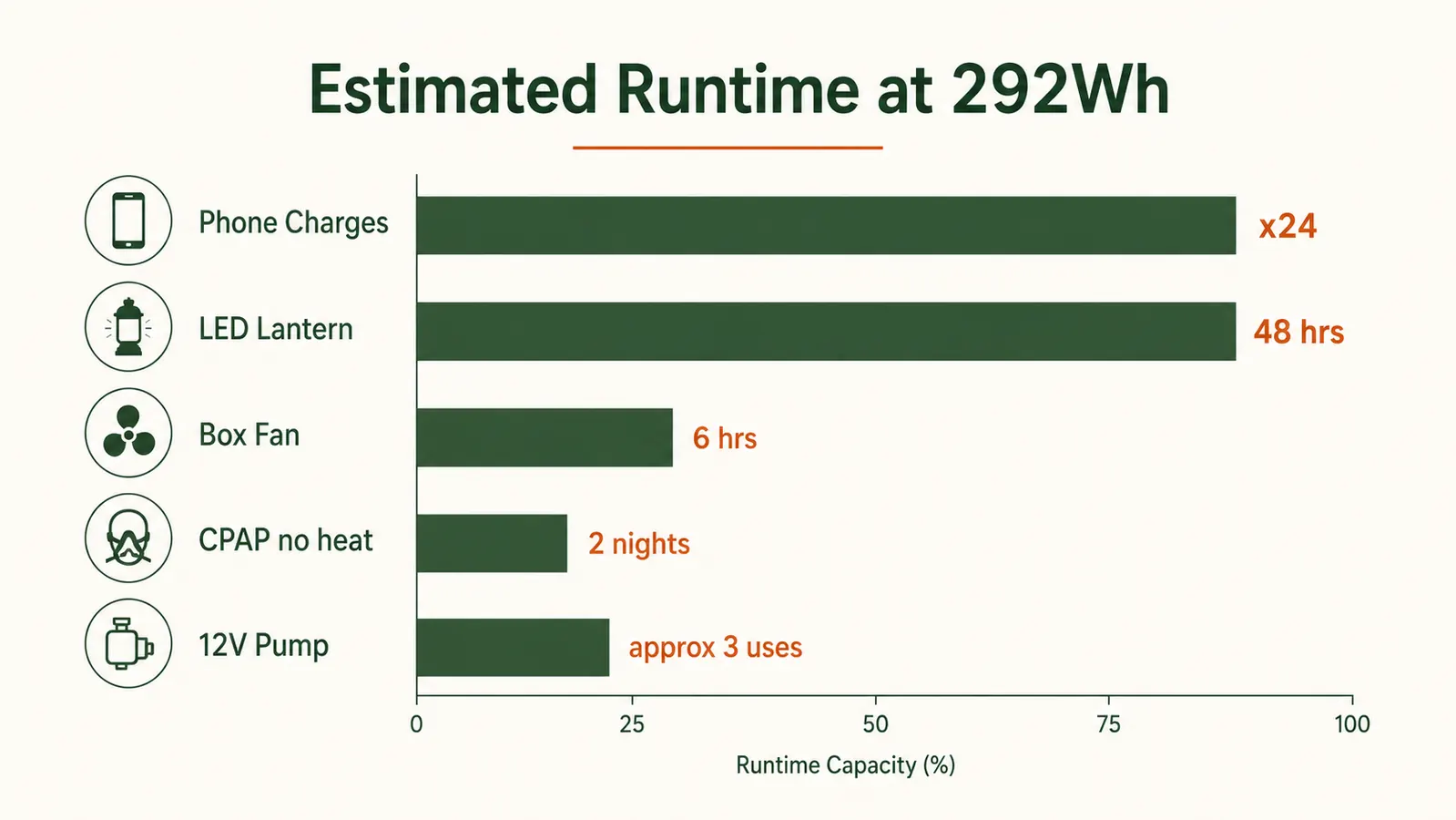
First: the capacity math will surprise you the first time if you have not done it in advance. At 292Wh with roughly 88 percent AC efficiency, you have about 257Wh of actual usable energy. A standard personal fan (35W) runs for about 7.3 hours. A low-draw CPAP without heated humidifier (30-40W) runs for 6-8 hours, which is just barely enough for one person for one night with no buffer. If you push either of those loads while also charging devices, you will not make it through an eight-hour night.
Second: the pass-through charging behavior. You can charge the Explorer 300 via solar or wall while simultaneously drawing from it. What Jackery does not highlight prominently is that pass-through charging (running loads while plugged into solar) reduces the battery lifespan over many cycles compared to charging first, then discharging. For occasional campers doing thirty weekends a year, this is a non-issue. For someone using it daily, it is worth knowing.
Third: the weight is 7.1 lbs, which sounds manageable but feels awkward to carry more than fifty feet because of the handle placement. It is a top-center handle on a box that wants to swing. If you are hauling it from your car to a walk-in site, it gets tedious fast. For a drive-up campsite where you set it on a table and leave it, this is a non-issue. For any site with more than a short walk from the lot, the weight distribution will annoy you.
Fourth: the 12V carport output is rated at 120W max draw, not the full 300W of the inverter. If you plan to run a 12V compressor pump or a 12V cooler directly from the carport, check the wattage of your device against this limit. My tire pump pulled 108W at peak and worked fine. A 12V powered cooler with a compressor can easily hit 120-150W and may not work well through the carport.
Fifth: the Explorer 300 uses a lithium-ion battery, not LiFePO4 (lithium iron phosphate). Jackery's newer units use LiFePO4 for better cycle life, but this model does not. Jackery rates it at 500 full charge cycles to 80 percent capacity. If you charge it from dead to full twice a month for camping, you will hit 500 cycles in about 20 years of that usage. That is fine for a weekend camper. But if you read reviews mentioning LiFePO4 as a reason to buy Jackery, know that those reviews are referring to newer Explorer Plus models, not this unit.
Sixth: there is no built-in solar controller bypass on this unit. It accepts solar input via Jackery's proprietary barrel connector, not a standard XT60 or Anderson connector. If you want to charge it from a third-party solar panel, you need an adapter, and adapters introduce additional conversion losses. Using Jackery's own SolarSaga panels avoids this entirely, but means you are locked into their ecosystem for solar charging.
What It Does Really Well
The AC outlets are full 110V pure sine wave. That matters for sensitive electronics like CPAP machines and some laptop chargers that reject modified sine output. I tested it with my wife's CPAP (Resmed AirSense 10, no humidifier, set to 8cm pressure) and it ran cleanly all night on one occasion with the station at full charge. That one night, the CPAP drew about 30W and the station was at 54 percent when she woke up. Not quite a full second night of CPAP without recharging, but plenty for a single night plus some device charging.
Phone charging is essentially free in terms of capacity impact. An iPhone 14 charging from 10 percent to 100 percent uses roughly 12-14Wh. A full charge of four phones takes about 50-55Wh, or roughly 19 percent of total capacity. If your camping power needs are mostly phone charging, a couple of USB lights, and running a camera battery, the Explorer 300 will handle a four-day trip with capacity to spare and barely any anxiety. This is the use case where the unit genuinely shines.
The build quality is solid for the price. The plastic housing has some flex but no creak. The outlets have rubber covers that stay attached (a detail some competitors skip). The handle is molded in, not a strap. The unit survived two trips in the back of my pickup bed inside a dry bag without any issues. The display did not develop any dead pixels or readout glitches after eight months of use.
If your camping power needs are phones, a camera, a few USB lights, and the occasional laptop top-off, the Explorer 300 will cover a four-day trip with capacity left over. The moment you add a fan or a CPAP to that list, you need to do the math first.
Recharging in the Field
From a standard 110V wall outlet, the Explorer 300 charges in about 5.5 hours. That is about what Jackery advertises, and it held up on multiple charges from an RV hookup at a campsite in Georgia. From a car's 12V socket (the cigarette lighter), it charges at a much slower 8-10 hours because most car sockets are limited to 120-150W output and there are conversion losses on both ends. I tried this once and found it impractical. If you plan to recharge from your car, you need to park and let it charge for half a day.
Solar input depends entirely on the panel. With a 100W panel under full sun, expect 80-90W of actual charging input, putting a full charge at roughly 3.5-4 hours of direct sun. I used a Jackery SolarSaga 100 on two trips. In real conditions in Florida in June, with some cloud movement and a non-ideal panel angle, I averaged closer to 55-65W input and needed a full day of sun to recover a depleted battery. In late spring in cloudier conditions further north, solar recharging is a marginal strategy unless you have multiple panels.
How It Compares to Alternatives at This Capacity
At the 256-320Wh capacity range, the main competitor most campers consider is the EcoFlow River 2. I have not personally owned the River 2, but I have looked at the specs carefully enough to understand the tradeoffs. The River 2 uses LiFePO4 chemistry (longer cycle life), charges faster via wall (under an hour with X-Stream charging), and has a higher continuous AC output (600W vs 300W for the Explorer 300). Where the Jackery wins is ecosystem maturity, brand reliability reputation, and the real-time wattage display clarity. If fast recharging and long-term battery longevity are your priorities, the River 2 is the stronger technical choice. If you want a straightforward unit from a well-established brand that just works, the Explorer 300 is very competitive. I go deeper on this comparison in the dedicated article on the Jackery Explorer 300 vs EcoFlow River 2 if you want the full side-by-side breakdown.
One thing I would not do is buy a 300Wh class station and try to run a mini-fridge, a coffee maker, or a space heater from it for more than a few minutes. Those devices pull 600-1500W. The Explorer 300 will shut off via its overload protection before you finish your first cup of coffee. If that is what you want to power, you need a 1000Wh or larger station.
What I Liked
- Real-time watt display tells you exactly how fast you are draining the battery
- Pure sine wave AC output works with CPAP machines and sensitive electronics
- Dead simple to use: power on, plug in, done
- Solid build quality with protective outlet covers
- Handles light camp loads (phones, lights, camera batteries) across a 3-4 day trip easily
- Charges from wall in about 5.5 hours, compatible with Jackery solar panels
Where It Falls Short
- 292Wh capacity is not enough for a fan running all night plus other loads
- Uses lithium-ion, not LiFePO4, so fewer rated cycles than newer competitors
- Proprietary charging connector limits third-party solar panel compatibility without an adapter
- Internal cooling fan is audible at high AC loads
- 12V carport output capped at 120W, limiting some compressor-based devices
- No dual-zone outlet control; everything runs off the same power budget at once
Who This Is For
The Jackery Explorer 300 is the right station for a weekend camper whose power list looks like this: four phones, a Bluetooth speaker, a camera with two batteries, a small LED light string, and maybe a laptop for a couple hours in the evening. That load profile sits comfortably inside 292Wh over a two-night trip. It also works well as a single-night CPAP solution if your machine runs at a modest pressure setting without heated humidification. If you camp at sites with hookups and just need the station as a backup or for convenience during setup and teardown, it handles that role with zero stress. For more detail on how to plan a full power setup around this unit, the guide on how to power devices camping with a power station walks through load planning and charging schedules step by step.
Who Should Skip It
Skip the Explorer 300 if you need to run a box fan overnight plus charge devices in a hot-weather location where you cannot sleep without moving air. You will run out of power before morning. Also skip it if your household has a CPAP user who needs the humidifier heated; the combination of CPAP heat humidifier (adds 50-100W to the draw) plus a full night will run the unit past empty. Finally, skip it if you want to run any cooking appliance, a space heater, or a compressor-based cooler for extended periods. The watt-hour math simply does not work at this capacity for those use cases, and no amount of brand reputation changes the physics.
Light loads, phones, and a CPAP without heat: this station handles all of it cleanly.
If your power needs fit inside what 292Wh can do, the Jackery Explorer 300 is a reliable, well-built choice. Check today's price on Amazon and see current availability.
Amazon Check Today's Price on Amazon →